Showing posts with label childhood. Show all posts

Friday, May 29, 2020

China Rose


On my way to work this morning, I picked up this flower. Bangla naam- Jawba phool. Scientific name- Hibiscus rosa sinensis. The two names have very different meanings for me. I taught a class on post-structural feminism recently. It took me a long time and multiple attempts of hitting my head on the wall to understand what is post-structuralism, what is feminism, and what is post-structural feminism in this context. However, it did help me develop an appreciation for the symbolic meanings of language once I vaguely understood the concept well enough to be able to teach it.

Jawba phool reminds me of Ma Kali. Of Shibpur, Howrah. And hajar haath Kali (goddess Kali with thousand hands, you should look up her picture. It gives me goosebumps, she looks so jagrata, so alive). All these are memories from my childhood, visiting hajar haath kali mondir in Shibpur and coming home to my grandparents’ place armed with two big bags of steaming hot boma. Boma means a bomb, and Chondi'r boma is the best alu’r chop that you will ever find. The story goes that Chondi, the inventor of boma, uses a secret spice recipe that no one else in the world has been able to replicate, and this humble family business over 3 generations did so well that he built a three-storey house. I do not know how much of this is true, but I do know that my mom spent years of her childhood bonding over boma with school friends, and I haven’t had it in decades now. So if anyone could get me hot bomas from Shibpur, you are my best friend for the rest of my life!

I don’t know how I jumped from jawba phool to boma, but the other name, Hibiscus rosa sinensis, opens up a whole new world of memories for me. I am in the ninth grade and Mrs. Khurana is our biology teacher. She has just taught us how to eviscerate the flower along its longitudinal axis to expose the reproductive contents using a dissecting needle. The catch is that during the practical exam, you only get one flower and one try to get it right. Sometimes, even surgeons are not as skilled as is expected of a 14 year-old. This would be followed by my vague attempt to neatly draw and label the parts of the flower, something I hated doing. I am so bad at drawing and sketching, I could not even draw a pumpkin, forget drawing the private parts of a dissected flower. I spent a good few months of my childhood surreptitiously plucking red flowers from the landlord’s garden and practicing my surgery skills on them. I might not know how to cook biryani or write R codes, but I can surely show you the reproductive parts of this red flower.

And of course now, the flower reminds me of the three-year old grandson of our neighbor who religiously sings me “mayer paye jawba hoye” in his mellifluous voice every time we meet. It is a devotional song dedicated to Ma Kali which means something like- I will be the flower of your feet.

sunshine

Tuesday, February 20, 2018

Money matters

An acquaintance's daughter recently bought her own plane ticket for a holiday trip by paying 2/3rd of the plane fare from her own savings. She is 9 years old!

I felt so proud of her when I learnt this. As a child, although I was never asked to, I would save up all the 10 and 20 rupees I got as birthday gifts from relatives (this was the eighties, so 10 and 20 rupees mattered a lot). Once in a while, you'd see a 6-year old me squatting on the floor and fervently counting my money. Then, my maternal grandpa would visit us, top off my savings and round it off, and buy me savings certificates from the bank and the post office that would double or treble my money after a certain number of years.

Actually let me back up a little bit. I knew my money even before I had learnt my numbers. I was very little when my grandma once left a green 5 rupee note/bill in my hand as she was leaving. I was asleep, and in my sleepy state, I knew that there was money in my hand. Later, my mom took away that money, lest I lose it. When I woke up and asked for it, my mom, unmindful, tucked a red two rupee note in my hand. I threw a tantrum, saying, "I don't want red money, I want green money." This was even before I was number literate. 

When I started tutoring students in my late-teens, it became even easier to save money. My habit of buying savings certificates continued, and so did my habit of counting money. I did not need grandpa's help anymore. Once I was counting the notes when a storm appeared all of a sudden and blew away two 500 rupee notes from the top floor balcony. That was the closest I have come to having a heart attack (I ran downstairs in lightning speed and retrieved them in time though).

The excitement of counting money is gone now, simply because there is no money to see, smell, touch, and count. It is all invisible money that gets deposited in a bank. Even then, paydays are my favorite days, and I excitedly log in to my bank account to see my bank balance increase. As kids, we were never encouraged to save or earn money. Doing odd jobs for money was seen as time wasted, time that could be spent studying and improving grades. As a result, I can afford a dozen trips to Utah now, but will never know the excitement of saving and buying my own travel tickets as a nine year old. 


sunshine

Monday, October 23, 2017

"We are going to Kolkata!"

This is a vivid memory from my childhood. I must have been around 5-6 years old, definitely not more than 8. We lived outside Bengal, and once or twice a year, we boarded the Madras Mail (an overnight train) as a family to visit Kolkata during summer or winter vacations. There, I spent significant amount of time in my mamar bari (my mother’s parental home). We were all a “joint family” back then, a family where parents, children, grandchildren, uncles, aunts, nephews and nieces, everyone lived under one roof. They show a lot of that in Greek and Italian movies.

My dadu or grandfather had two elder brothers, Boro dadu (boro means bigger or in this case, elder) and Mejo dadu (mejo means middle). They all lived in one huge, two-storied house in Howrah with their spouses, children, and grandchildren. The house had a “dalaan” or an open central courtyard that led to the well. There was a large wooden table in that dalaan. The table was so high for me that I needed support to prop myself and climb it. It is the same table where every male member of the family ate their breakfast before leaving for office. The table had a deep gash on one side and a nail sticking out on another. Even when I close my eyes now, I can still remember the feel of the table. For it was my favorite spot to lie on my belly, prop my chin with my hands, and watch the ongoing of the entire household; my three didas or grandmas lighting up their stoves to cook, the smell of burning coal that still makes me cry out of nostalgia, the domestic help, “Mongola’r Ma,” scurrying around to get chores done, my uncles busy eating rice and fish curry before leaving for work (always finishing the meal with “ombol”), and the neighbors dropping by to spread or garner news. 

I was too short to reach the wooden table, so I would use the adjacent chair to climb. That chair had a history too. “Buri pishi,” our widowed grandma (grandpa’s sister) sat there in the mornings, the two of us (the oldest and the youngest) being the only ones not in a hurry to get anywhere. So we sat side by side, buri pishi on the chair and I, belly flopping on the table, both of us with all the time to observe the world around us. Buri pishi often tickled my feet, catching me unaware, a constant source of annoyance. Till date, I hate anyone touching my feet. Given my size and height, the table offered an excellent vantage point to keep an eye on the ongoing of the entire household.

Sometimes, boro dadu or mejo dadu decked up early in the morning, wearing a fancy dhuti (a garment tied around the waist), a smart, cream colored shirt buttoned all the way without tucking in (unlike trousers), and dab generous amounts of Pond’s talcum powder on their face and chest. My own dadu never wore dhuti on a daily basis unless it was a wedding. He mostly wore a lungi or pajama. Anyway, the dadus would preen themselves, put on their best shoes, tuck a huge black umbrella under the armpit, and sit at one corner of the huge table for brunch before leaving home. Still lying on my belly, my chin propped on my hands, I would ask, “Where are you headed, dadu?” To which boro dadu or mejo dadu would beam proudly, “I am headed to Kolkata. I will be back in the evening.”

These words always made me giggle. I found this conversation hilarious. What do you mean, I am headed to Kolkata? We were already in Kolkata, weren’t we? How could one go to Kolkata while living in Kolkata? Back in our home, my mother used to tell everyone, “We are visiting my parents in Kolkata for the vacation.” To me, everything was Kolkata. I now understand the difference. We were technically in Howrah, a twin city to Kolkata separated by the Hoogli river. When we visited Victoria Memorial, we were in Kolkata. Whenever we took a bus and crossed Howrah Bridge, we were in Kolkata. When we ate moglai porota at the Shibpur tram depot, we were in Howrah. But in my little mind, technicalities were irrelevant and borders were non-existent. Everything was Kolkata, a nice and big city we visited during vacations or family weddings and met all the long-lost first, second, and third cousins, a place where a lot of people lived in one big house. Specifics did not matter to me back then. Demarcations were but only in the mind.

I have somehow held on to the trait even now. I continue to believe that Harvard University is in Boston although I have been corrected many times that it is in Cambridge. Seattle and the eastside are the same to me, one big place I call Seattle (unless I am in Seattle and have to go to Bellevue or Redmond).

“Where in Seattle do you live?” I have often asked people, only to be corrected and told, “We live in Issaquah/Bellevue/Kirkland/Redmond.” I know the difference, and I always laugh out loud when corrected. Little do they know that sometimes, I even refer to Portland as Seattle, although it is “just” 175 miles away. To me, Seattle means all of these- UW (which is actually in Seattle), my ex-office in Redmond, Inchin’s Bamboo Garden, Mayuri in Bellevue, and the amazing waterfront in Kirkland. Mount Rainier is in Seattle. Olympic National Park is in Seattle. You get the point. It is not that I cannot tell the difference. It is just that when it comes to Kolkata or Seattle, peripheries become all-encompassing and borders become non-existent.


sunshine

Thursday, June 09, 2016

Grand(father) memories

Dadu, my paternal grandfather, has been gone for more than 23 years now. What I have is mostly fragmented memories of him being annoyed with me most of the time and complaining to my ma, since I used to be naughty. As I write this, some random memories surface.

Dadu was a Hindustani classical singer. Every evening, he would religiously do riyaaz at home. He would practice using his harmonium, and dad would play the tabla whenever he was around. I would be expected to sit with him and do riyaaz as well which used to bore me to death. Often, to annoy him, I would mimic him singing aa-aa-aa-aaa-aa in a funny way. Once, I even told him, “Dadu, stop teaching me boring songs. Teach me some Bollywood songs.”

I once threw away his dentures on the garage roof. Just like that. He could not eat solids for days after that. 

8:40 pm news on Doordarshan, and he used to be glued to the TV. Which meant I had to start dancing right in front of the TV to annoy him.

He used to tell me stories. Action stories about ghosts and rajputro (prince). No romantic prince meets princess mush. There were many kinds of ghosts. Rakhhosh. Khokkosh. Petni. Shankchunni. Konnokaata bhoot. Bemmodityo bhoot. Once the story was over, I would always ask for the lyaj (tail). This meant that a few extra minutes had to be added to the story, since I was not done yet. So the ghost would be revived, and killed once again. Every afternoon I returned from school, I would cartwheel on the bed and wake him up from his afternoon nap for my story time. And his stories never put me to sleep. They were like action movies. If anything, I would be wide awake and listening.

He used to wear a blue and white vertical striped shirt that is so firmly etched in my memory that once I was dining out with a guy friend and I said, “Goodness, you are wearing a grandfather shirt.”

So that I am not scared of ghosts, he had taught me the mantra “Bhoot amar poot, petni amar jhi, Ram Lokkhon bukey aachey, korbe amar ki” (The ghosts are my sons and daughters. God is in my heart, so nothing can happen to me). I am all grown up now and live alone, but sometimes when I hear a sound and get startled, I involuntarily start chanting this mantra in my head really fast.

After his cerebral stroke, his hands used to shake while writing. So once, I deliberately wrote a letter to dad with shaky hands, and gave it to him, saying that dadu had a note for him.

He would not let us say the word snake in Bangla after sunset. Some superstition. So every now and then, I’d go really close to his ears and say, “Snake!” And all hell would break loose. 

Okay, last one. Dadu used to walk very slowly, with a stick, and was a nervous and panicky person. His favorite afternoon job was to go around the house and count the number of people, to make sure everyone except dad was home. So he would go count Dida, Ma, and my sister. But where am I? Well, I was really tiny and short then. So as he walked slowly, I used to tippy toe right behind him. He would be walking the entire house looking for me, without realizing that I am walking right behind him (remember those Tom & Jerry cartoons?). Even if he realized, he walked so slowly that by the time he turned around, I would have turned around with him too.

I wonder where he is now. If there is life after death, I realize that he would be a twenty-something young man now, in some corner of the world. Maybe still in college. Maybe trying to impress young chicks with his music. And hopefully with a lot of hair. Ever since I remember him, he was bald. Actually my dad says the same thing. He has always remembered dadu bald.


sunshine

Monday, May 02, 2016

Re-cycled

I started biking after some 18 years. Thoroughly out of breath, huffing and puffing, my muscles screaming, I could barely bike a few miles. It did not help that I could not figure out the gears, and there were like seven of them. 

I recently watched Piku, where they showed the 70-year old Amitabh Bachchan suddenly biking to Shyam Bazar and Dalhousie and God knows where one fine morning . That day, he biked like 12-15 miles? 

Given that Bollywood references are a central point in my life, I told a friend how unfit I am, wondering how the old man did it. 

Me: "I don't know how he did it."

My friend (impassive expression): 'Remember, he died the next day in his sleep."

Such thoughtful friends I have!


sunshine

Friday, April 29, 2016

For the love of language

A conversation heard in a crowded bus gave me goosebumps recently (a big reason I prefer taking the public transport rather than driving in isolation is the variety of people I get to see). In a tiny North German city, of all things, two people were conversing in Oriya!

You see, I am Bengali by ethnicity. Sure, we speak Bangla at home. However, I was never raised in Bengal. I was born in Bihar, and spent the first 16 and formative years of my life in Orissa. That's more years than I have lived anywhere else (9 in Kolkata, 8 in the US, 1 in Germany). I learnt to read and write the language in school, and used to speak fluently until I left Orissa. In school, most of my friends were native Oriya speakers. I was one of them. They were one of me.

We did not start growing roots in Bengal until my father decided to buy an apartment in Kolkata in the early nineties, forcing me to spend lonely summer vacations there. I had no friends. The topmost-floor, west-facing apartment that remained locked rest of the year was unbearably hot and smelled of concrete and cement, and the few highbrow, big-city coevals I met made no qualms in letting me know that I was not one of them and I was not welcome (although I spoke perfect Bangla with them). So I spent the summers reading voraciously, learning my Bangla alphabets at home, and finishing math chapters ahead of time. Oriya had such deep and comforting roots for me that the moment the train entered home (home being Orissa then), I would get dizzy with excitement seeing the Oriya letters imprinted bold black on a yellow background at the railway station.

It is not surprising that hearing the language after so long gave me goosebumps. A person who raises you is as much your mother as a person who gives you birth if they are not the same people. Although Bangla is my mother tongue, it is Oriya that raised me. I had barely started school when I said my first swear word (ghusuri, meaning a pig) in Oriya, long before I knew any Bangla swear words. Somehow, the other languages I spoke always stayed with me. Bangla, I speak everyday with my family or close friends. Hindi, I hear every day because of my addiction to Bollywood movies and music. But somehow, Oriya left me. I was never able to find people I could converse with on a regular basis. Suddenly, I was swept with nostalgia. I longed to visit the towns, the homes and the schools I grew up in. The guava tree where the monkeys lived and regularly invaded our home. The mango tree whose branches we used to hang ropes from, swinging with cousins in the summery afternoons. The huge black gate wherefrom our physician landlord used to enter in a bottle green ambassador every day. Such is the power of language that it took me on a 34 year long road down the memory lane.

My parents (both Bengali) have similar relationships with other languages. My mother with Hindi, and my father with Bhojpuri, because both of them spent significant years of their childhood in different places of Bihar. I wondered what language my children would yearn to hear, like I am doing for Oriya. Other than Bangla, they might grow up learning German. Or American English. I don't know. The deeper our roots grew, the wider our branches spread, the more we embraced different cultures. Maybe someday, I would feel similar nostalgia hearing German. The next time I am in Calcutta, I might make a trip to my childhood places. Walk the streets I haven't walked in 18 years. Touch the walls. Get excited reading off movie posters stuck on the walls, like I used to do as a kid. You see what havoc two strangers I heard speaking in the bus today wrought? They opened floodgates of nostalgic memories for me. They enlivened chapters from my childhood I had almost forgotten about.


sunshine

Wednesday, April 06, 2016

Poster Child

I was in the bus, on my way to work this morning, watching people, when a bygone memory from more than two decades ago made me nostalgic. We used to live in a little town, little enough that very few buses took you around, but big enough that the ride to school took about 45 minutes every morning. Every day, my sister and I would hop at the back of the cycle-rickshaw, enjoying the cool breeze and lack of traffic very early in the morning. And all through that ride, our favorite pastime was to count the number of cinema posters of Aamir Khan and Shah Rukh Khan, the two prominent actors in Bollywood. I was a non-supporter, but since sister was an Aamir supporter, my default poster counting went for Shah Rukh. 

We had rules too. Big time. When one of us would be losing, we would make impromptu rules, like the actor has to be visible on the poster to count. Or, we could not count posters that were old, and hidden beneath newer posters. And there was a way of counting too. Whenever we spotted one, the person would shout- Aamir 1, or Shah Rukh 12, making Raju Bhai, the rickshaw puller chuckle. Sometimes, when we felt generous, we would help the other person locate posters. But if we were our default mean selves, we would just say- "Hey, you just missed that poster on the wall, but since you cannot see it now, you cannot count it."

I do not see any point to this game now, but for strengthening counting abilities (it was already strong, I was in the eighth or ninth grade, my sister in the second grade), getting familiar with movie names like English Babu Desi Mem, Guddu, and Zamaana Dewaana, and just staying engaged during the long ride. The game was so pointless, so without any agenda, that it was good. So good that years later, I think about it and feel nostalgic, wishing that I could still be counting movie posters on my way to work now.


sunshine

Thursday, March 03, 2016

Little Accomplishments

If little children could write their CVs, what would those look like? At age three, Baby D’s would look like this:

1. Spearheaded an independent mission of running away from home by sneaking out from a tiny crack in the yard's wooden door and ending up on the streets.

2. Recalibrated and re-standardized security measures (both indoors and outdoors) by successfully managing to open the door of a car in motion, and managing to scare the living daylights out of my parents.

3. Negotiated my way through getting awesome deals and food treats by using my voice-power and by screaming my lungs out, rightfully earning the title of Baby D Bose. 

4. Experience with single-handed leading of missions like sneaking out a sharp knife from the drawer when no one was looking, and charging people in the room with full force, running towards them, knife in hand. This alone led the family to tighten security settings overnight, recheck drawer locks, improve their baby-proofing initiatives, and reinforce their faith in God because no one was hurt.

5. Motivated mommy to upgrade her collection of cosmetics by using the current ones for artwork on their walls and mirrors, also minimizing the need to hire interior decorators or buy expensive artwork in the process. 

6. Kept mommy fit and active with the sheer amount of running around after me.

7. Managed to mesmerize everyone with my charm and cuteness and melt their hearts despite doing all these things that I was never supposed to do.


sunshine

Saturday, June 27, 2015

An educational dream

Between the mid-eighties and the mid-nineties, my first school was one located in a small town in Orissa. I still have vivid memories of certain things there; the two mango trees, the bougainvillea tree right at the entrance, and the huge playground that smoked of dust. We did not have electric bells. A huge piece of metal used to hang from the branches of the mango tree, and the bell man would hop onto a paved wall, and bang the metal, hammer in hand, to ring the bell. Unsuspecting little children unaware of him around and playing happily would often get startled and start crying at the loud sound of metal that reached the far corners of the school, heralding the end of a class period.

For the longest time, I wanted to know where the nuns lived. One day, I got lost on purpose, and walked through a small garden to see a door slightly ajar. I peeped through, looking at a room with the most antique looking furniture and a huge piano sitting at a corner, with stained glass windows. They used to call it the parlor. This was also the time when I was beginning to read Bronte and Charles Dickens, and the room had looked straight out of one of these novels. I always thought that our nuns from the school had come here to teach from Ireland. Later, I learnt that most of them were from Kerala. Back then as a fourth grader, my secret desire was to convert to Christianity, become one of them, and spend my evenings reading at the parlor.

Last night, I had a very vivid dream. I dreamed that I was sitting on the ground by the trees with a few professors from Virginia, discussing research ideas, and a proposal we wanted to submit to the National Science Foundation. They had no inkling that this was my first school. Everything looked ten times vivid, there were greener and more mangoes on the trees, the oranges were really orange (although I do not remember an orange tree in school), and there were many more children playing around us. And sitting there by the shade of the trees, we discussed research ideas. In my dreams, we had transcended all barriers- country, visa, race, and language. I had gone back to where all the education had started. Of course when I woke up, the rational mind could not connect the dots and kept asking, "How is this possible?" But in my dreams, memories from my childhood and other recent memories had nicely merged into one single landscape.


sunshine

Friday, June 26, 2015

Memories from a childhood home

I often fondly remember visiting the home where my mother grew up. I used to spend a significant amount of my summer vacations here, doing "hurohuri" and "dushtumi" (childlike mischief) with the first cousins. We played with flowers plucked secretly from the neighbors' plants, broken pieces of earthen pots used to drink tea, pebbles, and other assortments that I used to have a lot of fun throwing into the well when no one was looking, watching the ripples in water expand. There was a hand pump behind the well, and my favorite activity used to be pumping water from it, my three feet form almost hanging like a monkey, it took so much effort to pump water. The domestic help led a fascinating life back then according to me because she could sweep floors, go to the nearby pond to wash clothes, and play with water all day.

This house used to be full of people. My three grandpas, three grandmas, and a bunch of uncles and aunts, the sons with the daughter-in-laws, and the daughters visiting with the son-in-laws. During a certain wedding in this house, I had gone missing one hot afternoon, only to be found next to one snoozing uncle, dancing to the music from the blaring loudspeakers by myself. Renting wedding homes were not in vogue back then.

There used to be a big wooden table in the balcony that led up to the well. That used to be my favorite hangout spot, where I would climb the table, lie on my belly, and watch the ongoing of the household, the grandmas lighting up the coal-fueled stoves to cook, the domestic help (Mongola'r ma, or Mongola's mother) scurrying around, and the men of the household busy eating rice and fish curry before they left for office. I always thought that the domestic help’s name was “Mongola's mother”, not understanding that her daughter's name is Mongola and we never knew her real name. Since I was too short to climb the table, I used props like chairs or hang on to other adults standing nearby to climb the table like a monkey. Once there, I used to get a good vantage point to see the entire household. Buri pishi, an old widowed grandma, used to sit near me, watching other people as well. She used to tickle my feet when unaware, something that really annoyed me.

After seeing better days, this house was locked for years, before meeting its expected fate, being sold to a Marwari contractor who eventually demolished it and raised matchbox apartments in its place. Most of the elders passed, and the other people moved on to newer and more modern homes closer to the city. And while this house met its expected fate, the many sights, smells, and sounds of my childhood remained locked within its doors. Waking up to the sound of the dhobi beating up the clothes in the nearby field also known as the washerman's field. Being warned not to go upstairs without an escort because the "chhele dhora" or the child kidnapper would vanish with little children hiding in his bag (a clever ploy to prevent children from venturing to the attic with low brick walls). And visiting the nearby Kali temple every evening, with a three-storied tall Kali goddess sporting one thousand hands, a sight to truly behold.


sunshine

Friday, June 19, 2015

Visitors

As a kid, I would anticipate my cousins' summer visits with a lot of excitement. Summers were so much fun, having three siblings to play with, instead of one. For six weeks, everyday would feel like Sunday. There would be endless playing, swinging from trees, getting dirt and mud everywhere, with very little monitoring from mom.

Mom would be very busy attending to more people in the household. Grandma would fry endless rounds of sweets, while fancy fish and meat dishes would be cooked every day. During the evenings, the elders would get busy watching movies, renting VCRs and videocassettes from the stores. This would give us even more time to play, with no school and homework. Once a day, there would be reminders about taking the shower on time, or finishing that Math chapter, but as long as you did not do something pretty drastic like set the room on fire or break a bone while jumping from the sofa, one could pretty much escape being constantly monitored.

Sometimes, we would all visit the nearby market for rounds of chaat and tandoori chicken resplendent with artificial red color. The memory of the smell of burnt meat in iron griddles still makes me nostalgic and hungry. We would hop on to rickshaws, and often wave to the cousins in excitement, my hair flying in the evening sea breeze as mercury dipped.

The older people passed, the cousins grew up, and we moved out. Summer vacations became meaningless after school. People got busier, the big homes turned into high rise buildings with matchbox apartments, and the thrill of computers replaced the joy of swinging from the trees and collecting raw mangoes in our skirts.

But I relived the excitement in my adult life every time someone visited my home. There are many friends who visited me during my eight-year long stay in the US. And instead of the childlike excitement with little responsibility, I saw myself doing some of what my mom used to do back then- cleaning the home, planning the food, and planning where to take my friends. The era of the childhood is gone, and what remained is the excitement recreated with different people, in an almost different life, in a different country. And as I write this, I realize that Facebook, Skype, WhatsApp, or even the phone can never replace the thrill of anticipating somebody's arrival in person. Nothing can replace the joy of meeting someone in person.


sunshine

Tuesday, February 18, 2014

The Healthy Daal

As children, we used to dread the days when ma made poushtik daal (a term she had coined, poushtik meaning healthy, and daal being lentils). We knew that excess vegetables were getting old in the fridge, especially spinach, and she was using fancy names to make us eat what she cooked. She would even throw in added incentives of a glowing skin, and sharper brain, if one regularly ate that. Not that the daal tasted bad or anything. In fact, true to its name, it was healthy, and had lots of vegetables. However, we had higher expectations from mommy's kitchen. We expected meat, and eggs, and fried stuff everyday.

I am stirring the pot as I write this, cooking the same poushtik daal for dinner. The spinach and the tomatoes have been in the fridge for a while now, and I am too tired to come up with fancy ideas of using it. I am tired at the end of the day, and want a shortcut menu for dinner. I want to throw everything in one pot, stir it a bit, eat it, and go to bed as soon as I can.

The older I get, the more I become like my mother.


sunshine

Tuesday, January 14, 2014

Food for thought

As a kid, I used to love peeling hot boiled potatoes because after I was done, I would be allowed to eat half a potato with salt. The taste was heavenly. No one told me that eating potatoes would make me fat, and I was never fat. If anything, I was active, always hungry for food, and loved eating whatever mom made, without counting calories.

There are some things I did not love so much though. But no one was given a concession. Everyone ate what was cooked. Alu sheddho deem sheddho dal sheddho bhaat was one of the things I did not like. It is a meal made of boiled and mashed eggs and potatoes, with boiled lentils (masoor dal) and boiled rice. The eggs and potatoes were mashed with finely chopped onions and green chilies, and the rice was served with ghee. People said that it tasted heavenly. I think the semi-solid consistency of the meal bothered me. You would have surely eaten this if you are Bengali.

I don’t remember the last time I ate it, since I didn’t like it anyway. It must be close to 8-9 years now. Yet today, out of nowhere, I started craving it at work. I craved it so much that it became distracting. I almost smelled it everywhere. So when I got home, I had to make it. Well, there is nothing to make actually, you boil everything and eat it while it is super hot. I got a little adventurous and put in a tadka of red chillies and finely chopped onions and garlic. The first morsel I had, I knew that I was in food Heaven.

Food is so much about childhood memories. The pizzas and the pastas will never be the same for me as Bengali food is, because I have no childhood associations with them. I grew up watching mom cook for years as I sat at my desk doing homework. I never worried about eating an extra potato, or eating that yolk in the egg. I never segregated food as carbohydrates, proteins, and fats. I ate whatever mom cooked. She never served canned or processed food, and cooked everything from the scratch. For me, certain food will always be about strong childhood associations. The smell of garlic I peeled as she made goat meat curry for Sunday lunch, the smell of tomato soup made from scratch on wintry nights, and the smell of cheese pakoras being fried when guests visited us, being some of them.

In the 1990s, I grew up watching my mom hooked to Khana Khazana (a cookery show on Zee TV). Those were the days when Sanjeev Kapoor had a mustache, and wasn't as thin as he is today. In the evenings, she would get all her cooking and chores done, and would sit with a tray of raw vegetables, her eyes glued to the TV.

I didn't really understand her fascination for the show. Some days, we would be having simple rice and lentils for dinner, yet meat sizzlers and fancy Italian cuisine would be cooking on TV. Sometimes, Mr. Kapoor used sauces and wines which I am sure were not available in any middle class kitchens in India. It is a different story now. 

The TV was mounted high up, so every evening, she would sit on the sofa, peeling peas or banana blossoms, her neck craned and her eyes glued on Mr. Kapoor, just like a devotee would look at God in the temple. No one else was allowed to watch anything else. Thankfully, there were no distractions from the cell phone or internet then. I never really understood her fascination for the show. If I interrupted her, she would simply make a STOP gesture with her palms, saying, "dnaara, dnaara" (wait, wait!!). Those days, I neither knew how to cook, nor was interested in watching these shows.

This evening, I spent quite some time doing exactly what she used to do all those years ago. I was intrigued about a breakfast recipe, and that is how it started. Before I knew, I had watched 15-20 episodes back to back. And at some point, I was like, "God, I must look exactly like my mom right now!". The difference is that I was watching it on my laptop, and they were talking in English. I watched a few back from the 90s as well, and loved the show in Hindi. 

We grow up watching our parents do many things, shaking our heads and not understanding what attracts them to these things. Then, years roll by, and one fine evening, even before you realize, you are the exact replica of your mother, grown older to that age roughly, glasses on the nose, watching the same shows they were addicted to. If I had children around me right now, I know that they too would be shaking their heads and wondering the same thing, "What is wrong with her? Why is she hooked to the show?"

sunshine

Monday, March 14, 2011

Diary of a Wimpy Kid: Book Review


Weighed down by a really heavy book (both in terms of actual mass and content mass) called “The Chosen: The Hidden History of Admission and Exclusion at Harvard, Yale, and Princeton” (don’t ask me why I read such books), I was looking for a light read that would take off some of the weight these Ivy Leagues had recently put on my shoulders. That is when a friend suggested I read “The Diary of a Wimpy Kid” by Jeff Kinney. What a fun read the book was, leaving a welcome breeze of lightness in its wake. A novel in cartoons, this is the story of a little guy who will remind us of our childhood, the days we hated school, the days we loved school, the pranks that backfired on us, the crazy teachers, the parents who never understood, and the little siblings who were an eternal pain in the ass. There are school friends you would never want to be seen with, yet sometimes circumstances demand that you pretend they were your best buddies. This is a typical guy book, but that would strike you odd as keeping a diary is a girly thing to do. I love the way the author has intermingled writing with illustrations. There are every possible characters you would have come across as a part of growing up- strict parents who always favor the siblings (or so you think), siblings who will never let you alone, classmates who you know are not half as smart as you are, but who are always outwitting you for some unfathomable reason. And of course there is the forbidden cheese, which no one can touch. To say less is to say more, and to say more is to take away the pleasure of reading it. If you want to revisit memories of childhood, and have often felt being wronged by friends, teachers, parents, or siblings an integral part of your growing up, you must read this book. There are a series of books written by the same author about the same wimpy kid, and I am waiting to get my hands on them.
sunshine

Sunday, November 22, 2009

“Friend”ly Distinction

Today when so many people we barely know are “friends” on our social networking sites, I am reminded of an episode long time ago. I think I was in class 4 or 5. I knew a girl in my class who I rarely interacted with. She had her own set of friends, belonged to a different state, spoke a different language, and had nothing in common with me. We sat in opposite corners of the classroom. She was short and I was tall, and thus never even stood close to each other in those queues we made during the assembly. The only time I heard her name and her voice was when the teacher took the class attendance every morning and I heard her “present ma’am”.

It so happened that my father happened to know her father, which we discovered accidentally. My father had to go meet her father for some work and asked me if I would like to tag along and visit my friend. I was not very excited at the thought of it and hence decided to stay home.

The rest of the story, we heard from my father. He was at their place when my friend entered to say hi. My father smiled and asked her if she knew he was her school friend’s father. To which she smiled and said yes, and corrected my father saying “Although she is not a friend, she is a classmate”.

My father was very intrigued with the wisdom of a 11 year old. When I heard this, I was angry at first, but later realized that what she said was not to demean or insult me, she just spoke the truth. We must have barely spoken 3 times in school, sat at different corners, never shared or food, never hung out with the same set of friends, and had nothing in common.

Years later, I still appreciate the wisdom of what she said. We use the word “friend” in very general terms, referring to anyone we meet in the train, work with, go to school with, are neighbors with, or even study in the same class with. You go to a class with classmates, go to work with colleagues, and so on. Friend cannot be a generalized word used to describe classmates, colleagues, or contacts. Someone who is not a friend doesn’t necessarily have to be an enemy. But not everyone you are civil to and in good terms with is a friend.

On the same note, it would be interesting to have categories like classmates, colleagues, contacts, neighbors, relatives, etc. on these social networking sites. True, not everyone is a friend.

sunshine

Monday, August 25, 2008

Holiday Homework

Remember the 2 month long summer holidays when the teachers wouldn’t let us be in peace? On the last day of the school, they would write documentaries on the blackboard that we were expected to dutifully copy in our school diaries, and then more dutifully and diligently complete in the next two months. Yes, I am talking about holiday homework, the assignments we were supposed to do amidst swinging from the trees with cousins visiting their maternal grandparents, and between eating mangoes during breakfast, lunch, and dinner? The teachers themselves would heave a sigh of relief because for the next two months, there would be no caning students, correcting piles of copies, and screaming at the miscreants who did not do their homework on time or confused themselves with the spelling of their and there. However, the poor students were expected to study everyday during holidays, the holiday homework ranging from one page of cursive handwriting daily, practicing five arithmetic sums everyday, doing a social studies project on the diverse food crops grown in India, and copying experimental diagrams of photosynthesis and refraction phenomenon from the science text books. Summer holidays were like being offered a huge bowl of yummy, deep brown fried gulab jamuns with one tiny fly dead and sticky on the sugar syrup of one of the janums. You could accept the huge bowl and eat as much as you like on the condition that you identified the fly on the correct jamun, clicked your fingers hard to get rid of the gooey mush that was once a fly, and devour the rest of the gulab jamuns without complaining. Summer holidays were meant to be for fun, for playing with neighbors and cousins without having to look at the clock, for not being in the strict schedule of coming back home at 6pm, washing the mud off your hand and feet, and start doing sums on algebra while mom shoved a huge glass of steaming milk with Horlicks under your nose. Most teachers tend to forget that they too were children once, or rather, they do remember that they were children once, remember vividly what sadists their own teachers had been and how they had spent their childhood doing holiday homework every summer, and thus had to pass the baton onto the next generation. I haven’t met a single teacher who would come to class on the last day before vacation started and would write something like this on the blackboard- “No holiday homework for you children ! Enjoy your summer and your childhood while it lasts.” Even the art and craft teacher had to give us homework of sticking ice cream spoons and making figures out of them, most of which the parents finished before the day school reopened.

Anyway, I just realized that it has been more than a decade since I was subjected to the torture of doing holiday homework during the summer vacations. So in order to relive those childhood days, I decided to think of some homework, and then to assign that to myself on the last day of the summer quarter, before the summer break started. So I went up to my newly acquired possession, my whiteboard looking all clean and pristine, and pretended as if I was the teacher. I took one of the marker pens and wrote this-

Holiday Homework- Summer of 2008


Go to the IMDB website.

Print the names of the top 250 movies, and then another list of top 50 movies based on genre (comedy, romance, drama, horror, etc.)

Go to the university website for the library page.

Look for the available dvds of the movies acquired from the list.

Place an order for the movies.

Watch them.

Every time you finish a movie, check off the movie’s name in the list.

Lot studied and miles already walked on the path of being an intellectual. Its summer time, and it is movie time now. Correction, it is fun time now, be it in whatever way.

Reliving the homework-free childhood I never really lived.

sunshine

Friday, May 30, 2008

Childhood Chocolate Memories

Opting out of a late lunch, I inserted the one dollar bill into the vending machine and watched with fascination as the bar of snickers fell with a thud on the floor. It wasn’t the first time I was using the vending machine as a convenient substitute for skipped meals. I unwrapped the bar, relishing it and licking my fingers with shameless greed till the wrapper was clean. I was a grown up, which meant that I wasn’t accountable or answerable to anyone for a midday meal of a chocolate bar. Yet somehow, this brought back sweet memories from my childhood when chocolates and candies meant so much more.

We never bought chocolates in our family. I am sure none of us did, waiting for the opportune moment as kids when a certain nice uncle would show up, and in the process of drinking tea and gulping sweets, would take out a bar of chocolates from his pocket. It is funny how you noticed the elevated rectangular thing in his pocket all this while, yet you were not allowed to seem too eager or keen. You were supposed to look coyly at your parents, seeking silent permission, when they would accede. Then you would be expected to thank the uncle, accept the chocolate, yet still not open it or eat it in front of the guests. Like a nice kid, you would put it back in the fridge, and forget about it. The uncle wasn’t supposed to know that the moment the door closed behind him (after thanking him again for his kindness and chocolate for the 113th time now), I would spring in action, somersault and jump, cross 7 mountains and 13 rivers, and sprint to reach the fridge and grab that bar of chocolate. Had that uncle been forgetful, he would have witnessed a very nasty scene of chocolate all over my hands and face on his way back to collecting his forgotten umbrella or car keys. Something quite contrary to the image that had been portrayed for the last couple of hours.

Our family used to be unique in another way. Chocolates were never divided among the two siblings. It was always divided equally into 4 shares. 3 out of the 4 shares went to me, my sister, and my dad respectively, while mom would have a bite of her share. Then, she would again distribute her share among us. Our family didn’t believe that chocolate was meant for kids. It was meant for everyone in the family. That included my grandfather as well, till he had all his teeth pulled out at 75.

The taste of chocolates never lingered in our mouths. No sooner did we finish our share (and mom’s share, and anything remaining, depending on who was stronger), we were expected to go brush our teeth. All my milk teeth removed have been attributable to my dental cavities. Last I heard, the dentist had made a small fortune out of the fees my dad paid him, and his son is attending a college in London thus. Yet as an incentive for the painful process of tooth pulling, I always bargained, argued, bickered, and cried for more chocolates.

The taste of chocolates in my childhood used to be much sweeter. This was perhaps because both quantity of consumption and the frequency of buying were powered in the hands of my mom. Even though you knew you had 8 small bars of chocolates in your share, you could not finish it off in one go. You were expected to save it for days till most of it either went to the ants or into the neighbor’s child’s stomach. Self-sacrifice and controlling greed were virtues that always stood with monstrosity against my chocolate munching. Things got worse especially after my little sister sprouted teeth and learnt to talk and complain and cry because after finishing my share, I would always eat her share. It didn’t matter that she wasn’t very fond of chocolates, the chocolates still had to be there every time I opened the fridge just to tempt me and torture me and teach me qualities such as self-restraint.

The chocolates of those days were very different from the chocolates of today. Not only were there less choices and less brands, there was a clear distinction between what chocolates must be had on what occasion. And while I write this, I can’t help but salivate profusely, thinking of the different memories of my childhood these chocolates bring back.

Like I said, we never bought expensive chocolates like Cadbury’s Dairy Milk or Five Star. These were always gifted to us by some generous uncle when he would visit our home and spend hours finishing a week’s worth tea supply and biscuits and sweets and pakore in return. As the protocol has been described earlier, you could not appear too eager to grab that chocolate bar from his pocket and disappear. You were to wish him and smile at him, make small talk, correct him for the umpteen number of time that you were in class 3 and not class 2, and then look at his extended hand shyly, thank him for the chocolate, and put it back in the fridge. If you did not do it, mom would do it for you, shut the fridge door, and hide the key somewhere on planet mars. Cadbury's (and 5 star) was the most expensive brand of chocolates we ever ate. Yet no chocolates were to be eaten in front of guests. I have eaten chocolates under cover, under the bed, inside the bathroom, hiding in the store room. There was a time chocolates used to be kept hidden in my clothes wardrobe and I would burrow my face inside to munch on chocolates at the pretext of taking out clothes.





Then again, there were candies that you could always bargain for whenever mom took you out with her for grocery shopping. The Mango Mood in its yellow wrapper seemed tastier than the real mangoes. As much as I hated munching paan, I loved Pan Pasand, more so because of the red coating it left in the tongue. Believe it or not, even at the age of 26, I fight with friends over my share of pan pasand. Still reminds me of Archana Joglekar and her “Shaadi aur tumse? Kabhi nahi”. The éclairs were yummiciously delicious, but a little more expensive (50 paisa each), hence usually the choice for birthday celebrations in class. The wrapper was an orange one, and not the golden one it is now. Maha Lacto used to be another of the favorites. I didn’t like Kismi Toffee Bar much. The genre of Amul chocolates was a cheaper substitute for dairy milk (Amul chocolates were still Rs.7.50 a bar while dairy milk was Rs.10.00). I especially loved the orange flavored bars. Another favorite was the Campco milk chocolate bar, perhaps the only white chocolate bar I knew of. Later when I discovered the bliss of Nestle Milkmaid, a brand of condensed milk, it tasted the same. Then there was the age old favorite Poppins, a cylindrical treat of colorful delight (I hated the green ones and loved the pineapple flavored yellow ones). Rola Cola was a later introduced cola flavored version of poppins.


The house of Cadburys itself held so many treats for me. Other than the bar and the five star, there were Gems that I loved to munch on in mouthfuls. Then there was another chocolate I forget the name of, probably Mr.Pops or something akin that was a chocolate version of a lollypop. Wafer chocolates had come much later in my life, and that is probably why I do not associated myself much with wafer chocolates like Kit Kat.

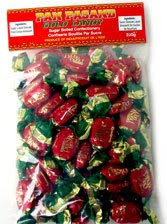


Chocolates and candies were not always chocolaty or sweet. There was this candy called Swad that made your eyes pop out of their sockets and corroded the upper surface of your palate. I still salivate profusely when I think of that jar of Hajmola granny would keep out of my reach, that farty smell whenever the lid was opened, and how you wanted to finish the entire bottle once you started munching on them. Then there were pillow packs of Hajmola Candy- Khatti Imli and Raseela Aam, mango being clearly my favorite. One of the memories I associate with my childhood is that ad of a little boy hiding under the bed, holding out a bottle to the stern looking teacher and saying- “Hajmola Sir”.


Much later in life, when elder siblings, their boyfriends and friends of friends of friends started to leave for the US and send things back, I actually learnt of chocolates like Snickers and Twix and Toblerone and Godiva. I had no knowledge of these as a kid. Hence even now that I am in the US, my hand always reaches out to that bottle of Pan Pasand or Hajmola Candy while shopping at the Indian grocery store. Like I said, I have very fond childhood memories of these. Childhood flew by, but even as a seemingly sensible and mature adult, the mind jumps with joy whenever a friend takes out a bar of chocolate from her bag. All the more if it is the good old dairy milk from the childhood Cadbury's days. Like I said, snickers and twix are always available in the vending machine. But whenever it comes to chocolaty matters, I'll always remain a desi at heart.


sunshine

Tuesday, July 24, 2007

Orkut- Bringing Lost Ones Together.

Orkut has had a profound impact on everyone’s life, and this is clear from the amount of writing I do about it. Orkut got me back in touch with many of my school mates. These are not the friends I had last met during the board exams. These are my friends from the nursery to the pre-puberty era before I had changed cities. Got hold of one, and got hold of most of the others through him.

The first thing that came as a shock to me is the way they look now. The boys are men, and the girls are women. Even their baby brothers and sisters who were in kindergarten are young men and women now. Browsing through the pics in their albums is a journey down the memory lane. 13 years of no contact, and I suddenly see that though their faces look still the same, they have grown mustaches and beards, and are taller and broader now. It feels strange to see so many girls married and with their babies the size of what I must have seen them first. And this brings back hilarious memories back from my kindergarten days. For I have seen these prim and proper men and women 23 years back, their noses running and hair oily while they cried the whole day. I even remember what their moms and dads looked like. There was this guy from my first standard who was so prone to skin disease that no one would want to sit near him. Yet I saw his recent pic, all brawny and on a bike, with his status “committed” (I wonder if he still has bad skin). There was this topper from my class who was all lanky a good 4” shorter than I was. Yet he is a 6’2” tall, muscular man now. When I talked to him over the telephone after so many years, I was so thrilled to hear his deep husky voice, a far cry from his girly voice in school. 

The guy who was first caught writing a love letter to some heartthrob in the fifth grade is a married man now. The guy whose dad would drop him in a rusty Luna drives a car now. Most of them are either in Bangalore or in the US. Most women are married now (a further reminder of my misspent youth, ha ha) with kids, while men are no exception. I have seen these people crying, fighting, making a queue while going to the restroom, peeing in their pants, cheating in the exams, standing on the bench or kneeling down with hands crossed around their ears, digging their noses, wearing half trousers, pinching and boxing others, eating their food in an uncouth, messy way, flinging chalk pieces and paper rockets at others, getting their ears boxed by the teachers, writing horribly funny answers in the exams that the teacher would later read out, and failing and repeating classes. It is so surprising that even after so many years, I remember their handwritings vividly, and so many incidents otherwise eventually forgotten. I am amazed at the sheer number of details these guys remember of me. During conversations, horror stories of our teachers often come up. “Remember the dance teacher who used to target everyone’s butt with that long, thin cane of his?” “Remember the language teacher who used to scream?” “Remember the teacher from class 1 who used to box everyone’s ears?” I still remember the signatures of most of the teachers, and how delighted we would be to earn “good” and “excellent” remarks from them. Most of the teachers have retired or have shifted elsewhere now. Some local friends even say that the school building has been remodeled, repainted, and looks nothing like what it used to then. But for me, it is still the same school, the same teachers who are a decade and a half older than what I remember of them, and my friends in half trousers and frilly frocks. It is amazing how I remember different people for different reasons. A certain guy used to wear a red sweater that had two holes on the right side. A certain guy would always have a running nose. A certain guy would always sleep in class. A certain girl had lice-infested hair. A certain guy always wrote his name in reverse, reminding me of ohm and mho. Strangely, I have their images in my mind still wearing the school uniform and the house badges.

The guy who had failed in math runs his business now. I wonder if he would find it weird when I met him. For we know these little secrets of each other, like who had bitched about whom, who had called whom a donkey, and who had pinched whom. My friend was so surprised when I told him that I remembered him bringing samosa and sweets for tiffin everyday from Calcutta Sweets, which he would eventually feed the crows during the lunch breaks. Even he did not remember that.

Well, such is the journey down the memory lane, and the bouts of nostalgia. For a moment I close my eyes and I can see those same faces, the same classrooms, the same teachers, the same books and the same chapters, and the same commotion in school. And then I open my eyes and everyone is grown up, scattered, leading their own lives in different parts of the world. And I keep wondering that like me, do they ever think of the bygone days, the fun and frolic, the naughtiness and the fun of being a kid in school?

sunshine.

Saturday, April 28, 2007

Childhood Memories-1 (The Gutter Baby).

It was a cold, wintry night back in the early 80s when I had just started school. Naturally, most details of the event are from my mom’s recounting them over and over again at every family get together.

It was a wedding we were attending and I must have been 3-ish. I was dressed in a white wedding gown my grandma had spent a fortune buying, the types bridesmaids wear in English weddings. Looking all cute and chubby and adorable, I went there with mom and dad.

Now I wasn’t a kid who used to jump on sofas or break stuff. I was a well-behaved kid, outside home. So while all the other kids were running around like crazy, I sat dutifully beside my mom, happily clinging to her and basking in the nice smells of her makeup and expensive silk saree. I am sure sitting on a chair my legs wouldn’t have reached the ground then.

After a volley of compliments from the other aunties, something on the lines of “Wow, what a cute little daughter you have, and she is so calm and well behaved”, my mom insisted that I go and play with the other kids. Not that I wanted to, I was more comfortable sitting with my mom. But then, since my mom insisted so much, I must have reluctantly gone to make friends with those monkeys running around and pulling at each other’s hair. Even there, not comfortable with befriending anyone, I marched towards a vacant chair at some quiet corner.

Now there was this huge drain/gutter in this rented wedding place which, instead of these morons securing with wooden planks, decided to cover up with thick cloth. And then they placed a few chairs close to it.

And of all chairs, I had to choose a broken one to sit on (Refer: Murphy’s Law). The moment I sat, the chair toppled, and the next moment I was neck deep in the drain, along with the cloth and chair.

Word traveled fast and someone yelled to the aunties- “Someone’s kid has fallen in the drain”. Now, almost all the moms ran to the spot, fearing if their child was the one. My mom however sat in peace, convinced that I wouldn’t have been the one running around and thus falling into the drain. Soon the other moms returned partially relieved and yelling at my mom- “Go, it’s you daughter in the gutter”.

My poor mom must have run for her life. Soon, I was lifted off the gutter by the armpits, my pretty white gown all brown and muddy, my little frame stinking like horse shit (or may be something worse). In that cold December night was I taken to the tube well and gallons of ice cold water was poured on me to wash me clean. Dinner be darned, mom had to carry my shivering self back home, which was quite far away. From dressing like a bridesmaid, I had returned home like a beggar, draped in nothing more but my mom’s shawl. And then my poor mom had to put up with a stinking baby the next few weeks.
So that is the story of a quiet baby falling into a gutter. Later, we heard that a few days earlier, a poor old woman, all dressed for the wedding had similarly fallen into the gutter. Even now, mom recounts this episode to others, or tells my granny-“Remember how she had fallen into the gutter……”. 

Anyway, a word of advice. Just watch your kids the next time you are in a gathering. Washing clothes from the gutter might not be a very pleasant thing to do. You can of course get rid of those, but you cannot get rid of the baby, can you?

Ever since, my mom calls me gutter-baby in jest.

sunshine.